
2025-09-19 / UCAC4 294-176411 / (23) Thalia
| # | OBS | Observer | Occ | Meth. | Instr. | CC | TSRC | UT1 | UT2 | UT3 | UT4 | UT2E | UT3E | Dur. | Chrd |
|---|---|---|---|---|---|---|---|---|---|---|---|---|---|---|---|
| 1 | show | Alfonso Noschese | O+ | VID | M300 | IT | GPS | 18:42:50 | 18:43:44.2 | 18:43:52.6 | 18:44:49 | 0.200 | 0.200 | 8.40 | 93.2 |
| 2 | show | Antonio Vecchione | O+ | VID | M250 | IT | GPS | 18:43:21 | 18:43:44.6 | 18:43:50.4 | 18:44:18 | 0.300 | 0.400 | 5.80 | 64.4 |
2 observations found in db: sodis
Available (probably) matching predictions (click on the link to switch):
| JPL#131 : 7475db80-ddb7-11f0-547e-28614bb6ba94 [db: observed] |
| Using prediction 7475db80-ddb7-11f0-547e-28614bb6ba94 for map and profile fit |
| Ellipse and circular profile fits to the timings (chords) |
|---|

|
Auto-Fit Result: X0,Y0 = 964.6, -27.9 km Circular diameter = 160 km From 2 chords (VID) You can enter space separated chord numbers (example: 11 4 8) or a method like VIS to ignore all visual timings, or a time source like RAD and NTP (but not GPS). If the plot disappears, then there are less than 2 chords left (too much ignored, go back with browser). Check SiMDA for size and mass data. Check Johnston Archive for satellites. |
Sky projection (artificial light) for occ. time: 2025-09-19, 18:42 UT (JD = 2460938.279)
| DAMIT | Q | P (h) | λ, β | JD0 | JD-JD0 | φ0 | Version | Modified | Vol-equiv D | Cmnt |
|---|---|---|---|---|---|---|---|---|---|---|
| # 122 | None | 12.312 | 159°, -45° | 2.438385e6 | 22553.3 | 0.0° | None | 2013-07-24 | 107.0 +/- 12.0 km | 2009-09-23 |
| # 123 | None | 12.312 | 343°, -69° | 2.438385e6 | 22553.3 | 0.0° | None | 2013-07-24 | 107.0 +/- 13.0 km | 2009-09-23 |
| # 1857 | 3.5 | 12.312 | 158°, -46° | 2.438385e6 | 22553.3 | 0.0° | None | 2017-09-21 | 115.0 +/- 8.0 km | 2017-09-21 |
| # 1858 | 3.5 | 12.312 | 343°, -74° | 2.438385e6 | 22553.3 | 0.0° | None | 2017-09-21 | 114.0 +/- 8.0 km | 2017-09-21 |
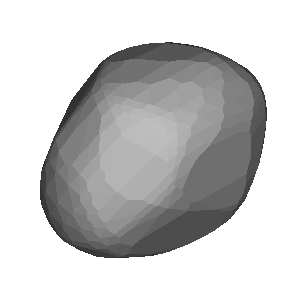
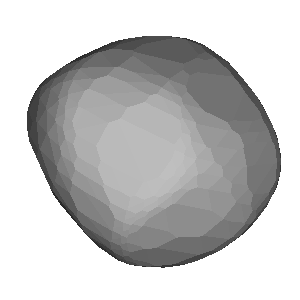
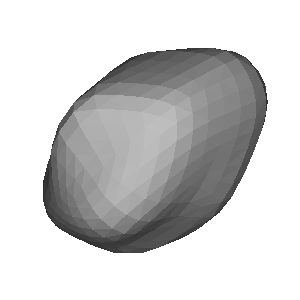
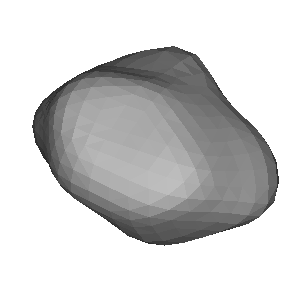
Image size: 300px. Transparent image background for copy & paste
| Map with groundtrack and observer stations |
|---|
| Event Details |
|---|
| More Data and Informations |
|---|
(If error 404: link not valid which means no data available)
| Aladin Sky Atlas |
|---|
Loading sky atlas…
Aladin Lite direct link (has Gaia overlay)